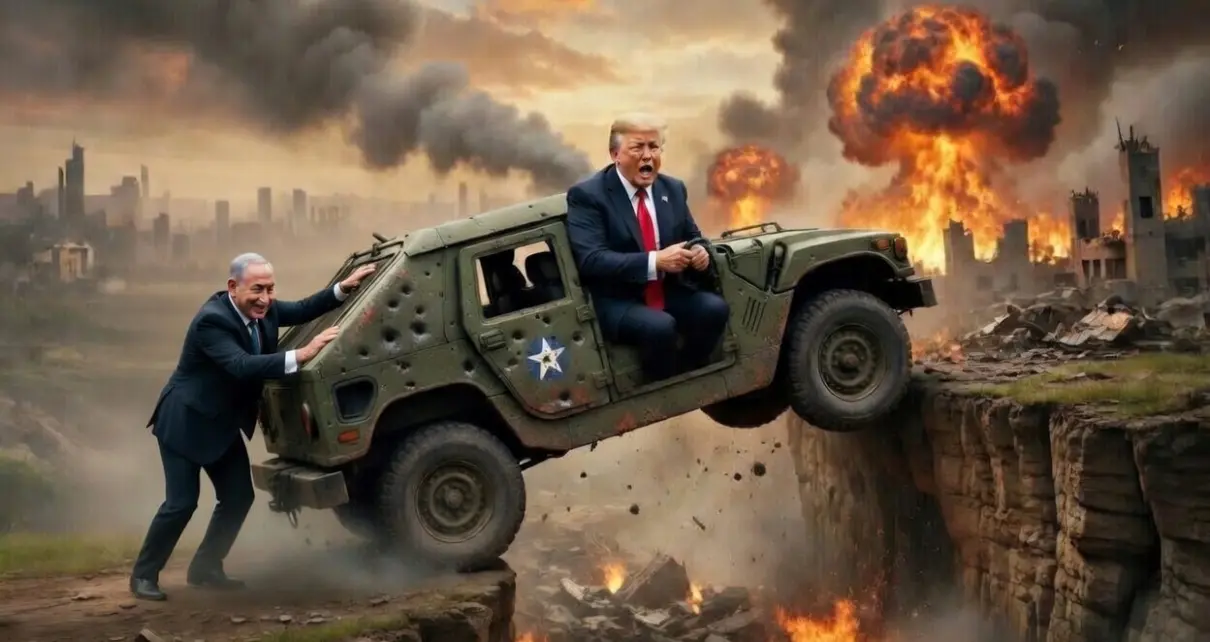
Despite the publicly espoused hubris of the Trump administration, its war of aggression against Iran has been a costly embarrassment, replete with failures. Yet its continuation is still being actively encouraged by Israel. This is because the Israeli goals remain unfulfilled, while Washington’s strategic interests are not a consideration in Tel Aviv.
When US President Donald Trump declared via Truth Social that a two-week ceasefire was being implemented to allow negotiations with Iran, the typical bravado that has characterized the administration’s attitudes toward the war prevailed. Both US Secretary of War Pete Hegseth and Trump claimed “victory.”
In reality, none of the war’s goals—as published by an official White House release—have been fulfilled. For example, Donald Trump is quoted in that release as saying:

“Our objectives are clear. First, we’re destroying Iran’s missile capabilities… and their capacity to produce brand new ones — pretty good ones they make. Second, we’re annihilating their navy… Third, we’re ensuring that the world’s number one sponsor of terror can never obtain a nuclear weapon… And finally, we’re ensuring that the Iranian regime cannot continue to arm, fund, and direct terrorist armies outside of their borders.”
Other US officials, who appear to note different objectives, were also directly quoted in the White House release. These include the Chairman of the Joint Chiefs of Staff, General Dan Caine, who stated:
“The Operation was again launched with clear military objectives designed to dismantle Iran’s ability to project power outside of its borders, both today and in the future. First, we are targeting and eliminating Iran’s ballistic missile systems to prevent them from threatening the U.S. forces, partners, and interests in the region. Second, we are destroying the Iranian navy, degrading its capacity capability and ability to conduct operations… Third, we’re ensuring Iran cannot rapidly rebuild or reconstitute its combat capability.”
Operation Epic Fail?
While the above-quoted US objectives are far from the only reasons cited by Trump administration officials (including the President himself), they are the most consistently mentioned ones.
The reasoning behind the motivations for the war has also shifted repeatedly. One of the most prominent has been the alleged killing of tens of thousands of Iranian protesters back in January. Just prior to the war, Trump claimed that 32,000 Iranian protesters were killed. In early March he began claiming the number was really 35,000, before continuing to increase that number up to 45,000. After each contradictory number, the President has consistently insisted that the death toll was “perhaps much more,” leading some MAGA influencers to begin claiming the number was “over 100,000.”
As for the imminent threat allegedly posed by Iran that allegedly triggered a surprise attack, there is not even a clearly defined narrative. US Secretary of State Marco Rubio claimed that the reason for the US attack was that Israel had said it was going to strike Iran, so the United States had decided it had to join in because it or its regional assets were perhaps going to come under fire.
🇺🇸🇮🇷🇮🇱 Secretary of State Marco Rubio literally admits we are at war with Iran because of Israel:
— HOT SPOT (@HotSpotHotSpot) March 3, 2026
"The president made the very wise decision—we knew that there was going to be an Israeli action, we knew that that would precipitate an attack against American forces, and we knew… pic.twitter.com/mpovs8JIG4
Ruling out the imminent threat—especially since Iran had just offered the US precisely what it wanted during Omani-mediated negotiations—the American-Israeli coalition decided to carry out a surprise attack under the cover of diplomacy. This underhanded tactic is one that has been employed many times over the years by both the US and Israeli governments.
Overall, the war was said to have cost an average of $1 billion per day, which would amount to just over $40 billion in only 40 some days. This figure, however, is a huge undercount, as various other costs are not included. For example, on February 28, an Iranian Shahed drone destroyed a US AN/FPS-132 early warning radar system at the Al-Udeid Airbase in Qatar, worth $1.1 billion alone.
In the space of less than three days, Iran shot down an F-15E fighter jet worth $100 million; the US lost two A-10 Warthogs costing around $20 million; four MH-6 Little Bird helicopters costing around $4.5 million each; two C-130 transport aircraft worth approximately $100 million each; and two UH-60 Black Hawk helicopters were damaged, with each costing between $20 million to $80 million depending on the version. A total of 24 MQ-9 Reaper drones and several MQ-4 Global Hawk UAVs were also downed by Iran, costing over $3 billion.
This is not to mention the currently unspecified losses of air defense systems. According to reports, three THAAD missile systems were destroyed or badly damaged. Each THAAD system can cost up to $2.8 billion, while the interceptor missiles for that system alone cost over $12 million per munition.
Although Trump and Hegseth claim to have “destroyed Iran’s air defenses,” this is clearly false. As for the navy, it reportedly remains largely intact, with most of its assets strategically hidden underground. The regional alliances that the US accuses of “sponsoring terrorist organizations” are still intact. Iran’s capacity to produce and fire missiles is also evidently still intact, as shown by its continued daily launches across the region.
As for projection of its power, Iran has increased dramatically. The Strait of Hormuz is currently under Iran’s direct control, forcing all nations around the world to coordinate with Tehran if they wish to transit the Persian Gulf. In this sense, the war has transformed Tehran into a major international player with far more leverage than it held before the conflict began.
While officials in Washington pretend that they have already achieved a regime change and that Iran had been militarily defeated, a truly battered and defeated Tehran would not be worth negotiating with in the first place. Instead, the pressure of the oil market and creeping inflation were becoming a huge burden. The US even began lifting some sanctions on Iranian oil to help stabilize the market and temporarily lifted sanctions on Russia—two significant retreats.
It also appears that the NATO alliance had been greatly impacted by the conflict, while Washington wasted strategic weapons en-masse to support an Israeli war effort. This has left the US more vulnerable in arenas where the other two major world powers continue to challenge it.
Nevertheless, Israeli Prime Minister Benjamin Netanyahu asserted right after the two-week cessation of hostilities was declared that “the war is not over,” arguing that this is simply a pause while other war fronts present themselves. Tel Aviv immediately sought to escalate tensions in neighboring Lebanon, killing over 300 people in a single wave of strikes that lasted around 10 minutes, before bombing Gaza once again.
Although over a dozen US bases have been destroyed by Iranian strikes, America’s Persian Gulf allies have taken serious blows, and the economic repercussions continue to unfold. What is clear is that neither Iran nor Israel has been dealt a decisive blow. If anything, Netanyahu has been emboldened by the war so far, while the Iranians have gained immense confidence after proving they could fend off an all-out aerial offensive from the world’s top military superpower.
This leaves two main options going forward: either some kind of temporary ceasefire is reached—in which case we simply wait for the next Israeli offensive—or the war will rage on for many more months.