
 |
| click image to enlarge |
James Hall, Contributor
Activist Post
Anyone who has offspring attending university knows all too well the spiraling costs of higher education. While purchases at the grocery or gas pump jumps at alarming rates, the expense of tuition over the past few decades have been in a league all of its own.
In the essay, College Education Economics, the subject of the student debt is analyzed. This essay examines the primary reasons why the price of educational institutions so dramatically outpaces the nominal rate of inflation.
For even the casual observer, it is indisputable that colleges are big business and universities are renowned franchise conglomerates. The supposed stated purpose of these schools, the education of students, is often lost in the bureaucratic traps of academia.
Funding the fixed costs of running citadels of bricks and mortar, escalate with every new addition or expansion. Therefore, the constant pressure to increase enrollment and the recruitment marketing of these high-priced diploma mills of marginally useful degrees grows uninterrupted.
The topic of Skyrocketing College Costs by Gordon H. Wadsworth, helps explain the reasons why educational institutions charge such expensive fees.
College tuitions soar each year, advancing far in excess of the inflation rate. The overall inflation rate since 1986 increased 100.14%, which is why we pay nearly double for everything we buy. On the other hand, during the same time, tuition increased a whopping 412.62%.
Yet, the main reason tuition continues to rise is a dramatic change that took place regarding the Federal Stafford Loan more than a decade ago. When Uncle Sam opened the floodgates to government-backed student loans without parent income restrictions in 1992, colleges welcomed the news with open arms. The sudden injection of millions of additional aid dollars only furthered tuition increases. Add to that the government’s continued promotion of the Stafford Loan as a low-cost program, and you have the formula for hyperinflationary costs.
Now you constantly hear that tuition and fees only pay for a portion of the total costs. Seldom admitted is that academic expenses are a secondary factor, when viewed in the context of the real functions of universities. The often hidden partnership between the educational establishment and corporate/government research objectives, reveals a predominate explanation for the huge expenditure of such institutions.
 |
| click image to enlarge |
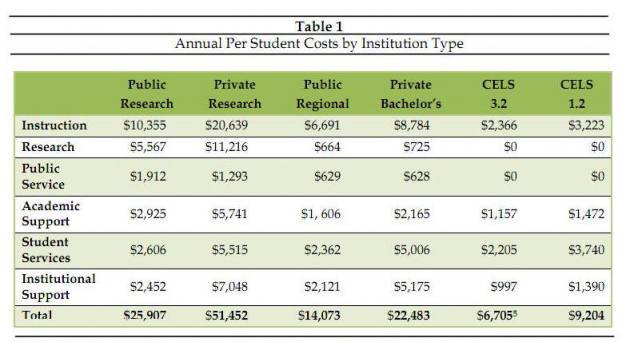
The Cost of Education site presents a stark assessment of the Leading reasons for high college costs are research and public service.
As part of his new study, Opportunities for Efficiency and Innovation: A Primer on How to Cut College Costs, Vance Fried created a hypothetical college to find more efficient ways to run institutions of higher learning.
Since CELS’s primary focus is on undergraduate education, the most obvious spending cuts built into the hypothetical budget are to eliminate spending on research and public service. While these may be worthwhile activities in their own right, they add little, if any, to undergraduate education.
 The COE article concludes:
Research costs are actually underreported, (in the above table) because industry accounting convention allocates most faculty salaries to instruction even though some faculty spend much time doing research. Consequently, about 40% of instruction costs at research universities are actually research costs.
The net result is that the students are targeted to fund a good portion of this research emphasis. What the corporatist is unwilling to pay for or the government to grant subsidization, the fall back burden is to raise tuition.
This is especially a handy technique when student loans are so freely provided to make up the difference.
The rate of inflation reported by official statistics is suspect at best.
Consider Time magazine’s article, What’s Your Personal Inflation Rate?, which provides an interesting approach to the question.
The fundamental problem is that people – economists and laypeople alike – talk about inflation as though it can be measured accurately and represented by a single number. In reality, though, inflation is a judgment call and varies enormously depending on what part of the economy is under consideration. The inflation figures that economists use when they calculate statistics can differ enormously from what you experience at the grocery store. In fact, you could say that every person has his or her own individual inflation rate.
Just ask the parents of any college student if inflation is nominal. Somehow, a $30,000 new car seems cheap, when compared to a total cost of $50,000 + a year at many schools. The deceptive grants and scholarship shuffle just placates normal common sense, that goes into most major expenditure purchases.
 As the buying power of the dollar falls precipitously, it is inevitable that a fundamental reform in substance and emphasis is needed at most higher education institutions. The old formula of expanding the college rolls to increase the cash flow is a failed model. The day of easy living is over.
As long as the federal government uses university research facilities as “play pens” for their next level of predatory technology, the annual budgets of such facilities will not be trimmed back. Thus, the dilemma for the next generation of college students just intensifies.
Expect even greater degrees of government intrusion into the financing of approved institutes of establishment acceptability. The path for a lifetime of indentured servitude is coupled to the lowering of real after-tax income. Anticipate a dreadful response and conditions to the shaky college loan programs. The central government will inflict greater public service requirements as the price of a tuition check.
On top of the financing problems, the fact that the incoming students are often not qualified to study at the university level implies an even greater lowering of educational standards. The implication strongly evokes that the inflation rate to pay for the luxury of a leisure lifestyle does not resolve the financial burden of the absurd degree “paper chase”.
Honest education starts with getting what you pay for. College and university administrators and trustees need to reinvent their methods of operation and return to the sound practice of providing genuine educational instruction in the art of learning.
Original article archived here
James Hall is a reformed, former political operative. This pundit’s formal instruction in History, Philosophy and Political Science served as training for activism, on the staff of several politicians and in many campaigns. A believer in authentic Public Service, independent business interests were pursued in the private sector. Speculation in markets, and international business investments, allowed for extensive travel and a world view for commerce. Hall is the publisher of BREAKING ALL THE RULES. Contact batr@batr.org

linkwithin_text=’Related Articles:’
Be the first to comment on "Gap Between College Costs and Inflation"