Tracking the Economic Impact of the Trump Trade War
The Tax Foundation reports Trump Tariffs: Tracking the Economic Impact of the Trump Trade War
- President Trump has imposed International Emergency Economic Powers Act (IEEPA) tariffs on US trading partners, including China, Canada, Mexico, and the EU. In addition, he has threatened and imposed Section 232 tariffs on autos, heavy trucks, steel, aluminum, lumber, furniture, semiconductors, pharmaceuticals, and copper, among others.
- The Trump tariffs amount to an average tax increase per US household of $1,100 in 2025 and $1,400 in 2026.
- Under the tariffs imposed and scheduled as of November 1, the weighted average applied tariff rate on all imports rises to 15.8 percent, and the average effective tariff rate, reflecting behavioral responses, rises to 11.2 percent—the highest average rate since 1943.
- The Trump tariffs are the largest US tax increase as a percent of GDP (0.47 percent for 2025) since 1993.
- Trump’s imposed tariffs will raise $2.1 trillion in revenue over the next decade on a conventional basis and reduce US GDP by 0.5 percent, all before foreign retaliation. Accounting for negative economic effects, the revenue raised by the tariffs falls to $1.6 trillion over the next decade. The Trump tariffs threaten to offset much of the economic benefits of the new tax cuts, while falling short of paying for them.
- The US Supreme Court will soon decide whether the president’s emergency powers under IEEPA include the power to impose tariffs.
- Historical evidence and recent studies show that tariffs are taxes that raise prices and reduce available quantities of goods and services for US businesses and consumers, resulting in lower income, reduced employment, and lower economic output.


What If Tariffs Enjoined?

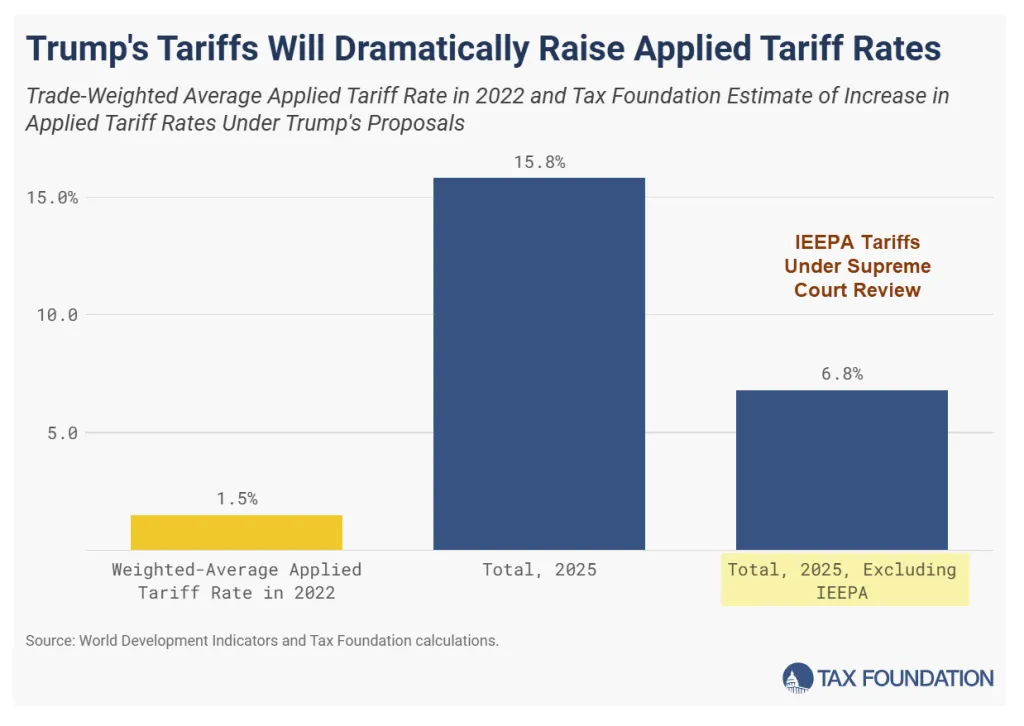
The new tariffs will significantly raise the tariff rates the US applies to most imports. According to the World Bank, the weighted average applied tariff was 1.5 percent in 2022. We estimate that under the tariffs currently imposed and scheduled, it rises by 14.3 percentage points to 15.8 percent.
However, if the IEEPA tariffs are permanently enjoined, it will rise by 5.3 percentage points to 6.8 percent. The weighted average applied tariff rate measures the rate imposed on different products from different countries, and it differs from averages measured by actual tariff revenues as a share of total goods imports.
That tax analysis assumes Trump will not result to other tariff measures.
However, he is certain to do so. Trump’s likelihood of success depends on method.
Economic Impacts
On May 28, a panel of judges at the US International Court of Trade unanimously ruled that the IEEPA tariffs were illegal, a decision that was upheld by the US Court of Appeals. Our estimates below separate the effects of the IEEPA tariffs from the Section 232 tariffs, which were not affected by the rulings. See the Appendix for a detailed explanation of the modeled provisions.
We estimate that before accounting for any foreign retaliation, the Section 232 tariffs will reduce long-run US GDP by 0.2 percent. The IEEPA tariffs, including the scheduled “reciprocal” tariffs, will reduce long-run GDP by an additional 0.4 percent if they are upheld by the courts and remain in place.
As of September 1, threatened and imposed retaliatory tariffs affect $223 billion of US exports based on 2024 US import values; if fully imposed, we estimate they will reduce long-run US GDP by 0.2 percent. Combined, the US-imposed tariffs and the threatened and imposed retaliatory tariffs reduce long-run US GDP by 0.7 percent. Totals may not sum due to rounding.
Revenue Collection
we estimate the tariffs will raise $2.1 trillion on a conventional basis and $1.6 trillion on a dynamic basis from 2025 through 2034.
On a conventional basis, before incorporating negative economic effects, we estimate that the Section 232 tariffs will increase US federal tax revenue by $602 billion over the next decade. The IEEPA tariffs will raise an additional $1.5 trillion in revenue over the next decade. The IEEPA tariffs raise less in 2025 than in later years because they will not be in effect for the full calendar year.
On a dynamic basis, incorporating the negative effects of the US-imposed tariffs on the US economy, we estimate that the Section 232 tariffs will raise $447 billion over the next decade, about $155 billion less than the conventional estimate. The IEEPA tariffs will raise an additional $1.2 trillion over the next decade, about $318 billion less than the conventional estimate. Incorporating the negative effects of imposed retaliatory tariffs as of September 1, 2025, further reduces 10-year revenue by $146 billion.
Distributional Impacts
In 2026, the Section 232 tariffs will reduce after-tax incomes by 0.3 percent on average, while the IEEPA tariffs will reduce after-tax incomes by 0.9 percent on average. The top 1 percent will see a smaller reduction in after-tax income. Per US household, the tariffs altogether will amount to an average tax increase of $1,100 in 2025 and $1,400 in 2026. However, if the IEEPA tariffs are permanently enjoined, the tax increases will be smaller at $300 in 2025 and $400 in 2026. Notably, these averages do not capture additional costs to US households stemming from higher-priced alternative goods and loss of consumer choice.
If the Supreme Court rejects the tariffs the bond market is likely to react negatively due to the reduction in income.
However, the stock market should like the news.
Related Posts
On November 16, 2025, I addressed the question What Are the Odds the Supreme Court Rules Against Trump on Tariffs?
The Supreme Court decision is not random. I discuss a framework.
December 3, 2025: Costco Sues Trump Administration for Full Refund of Reciprocal Tariffs
I commend Costco for standing up to Trump’s unconstitutional order.
I expect a 6-3 ruling against Trump that in practice ought to be unanimous.
December 29, 2025: Will Tariffs Be Refunded If the Supreme Court Strikes Them Down?
Polymarket provides no guidance because that bet expired December 31.
January 1, 2026: Three More Trump Tariff TACOs on Furniture, Kitchen Cabinets, and Pasta
To fight inflation, that Trump denies exists, comes another round of TACOs.
This post originated on MishTalk.Com
Thanks for Tuning In!
Mish