

Story at-a-glance
- Vitamin D and magnesium work together to regulate muscle contraction, energy production, bone strength, and recovery, forming a nutrient pairing that determines how effectively your body responds to training
- Research consisting of professional and Olympic sports shows widespread vitamin D and magnesium deficiency, which raises injury risk, slows recovery, weakens strength, and reduces endurance through impaired calcium and adenosine triphosphate (ATP) function
- Magnesium deficiency often hides behind normal blood tests, disrupts cellular energy production, worsens fatigue and cramps, and increases soreness, especially in endurance athletes training hard or in hot environments
- Endurance exercise increases magnesium needs by shifting the mineral into working muscles and increasing losses through sweat and urine
- Supplementing magnesium and vitamin D together improves strength, endurance, recovery, and soreness within weeks, particularly in athletes starting deficient or training at high volumes, without increasing workout intensity
Are you an avid exerciser trying to break a personal record? Once you reach a point where you feel confident, there comes a time when you’ll want to take your athleticism to the next level. To do that, the usual answer is to train even harder. However, this approach may not be even needed at all. In fact, the key to better performance could be as simple as addressing certain nutrient deficiencies.
The reason why many athletes aren’t performing well enough as they’d like is because they’re deficient in vitamin D and magnesium. Research shows that these two work together to provide the energy your muscles need to perform their very best. They also affect other biological processes, such as bone strength and stamina, which is why it’s in your best interest to make sure these are at optimal levels.


The Interplay Between Vitamin D and Magnesium

A review published in the journal Nutrients examined how vitamin D and magnesium shape athletic performance, recovery, and injury risk across multiple sports. The researchers combed through more than 200 studies identify how these deficiencies appear in athletes and explain why low levels quietly undermine strength, endurance, and resilience. The populations covered in this review included professional, Olympic, Paralympic, and recreational athletes across endurance, power, and team sports.1
•Nutrient deficiencies were common — The researchers discovered these findings even in elite competitors with access to medical teams and nutrition guidance. They also consistently linked low vitamin D and magnesium levels to higher injury rates, slower recovery, and impaired muscle function.
That means if you’re becoming more prone to injury, or stuck in a performance plateau, you could be lacking certain nutrients instead. Realizing this can prevent you from overtraining to compensate.
•The extent of vitamin D deficiency among athletes — The review reported that 32% of professional basketball players qualified as vitamin D deficient, while nearly half fell below optimal levels. Meanwhile, 26% of National Football League (NFL) athletes are deficient, and 42% to 80% have insufficient levels. Weightlifters, runners, volleyball players, swimmers, and taekwondo practitioners were also found to be deficient in this nutrient.
These findings carry strong implications because vitamin D regulates calcium movement into muscle and bone.2 When levels stay low, muscle contractions lose efficiency and bones lose density, raising the risk of stress fractures and chronic pain.3 For an athlete, that translates into weaker lifts, slower sprints, and more time off due to injury.
•Magnesium deficiency emerged as an equally serious but more hidden problem — The authors described how endurance exercise increases magnesium needs by shifting the mineral into working muscles and increasing losses through sweat and urine.
Even athletes who met the standard dietary allowance still showed signs of deficiency. A meta-analysis cited in the review found that most athletes failed to meet daily magnesium requirements, despite higher overall calorie intake.
•The importance of proper testing — The review highlighted a study of British Olympic and Paralympic athletes showing that about 22% had intracellular magnesium deficiency despite normal blood magnesium values. However, not many are familiar with this condition, as deficiency often doesn’t present symptoms:4
“Although the signs of magnesium deficiency are often nonspecific, suboptimal magnesium levels should be considered when persistent symptoms such as muscle cramps or spasms, fatigue, low endurance, irritability, poor sleep, delayed recovery, or increased injury risk are present,” the researchers reported.
“The serum magnesium level may not reflect cellular levels, but it will exclude severe deficiency.”
•How different variables influenced nutrient outcomes — Athletes training in hot environments or at high volumes showed greater magnesium losses than those in cooler conditions or lower training loads.
Indoor athletes and those living at higher latitudes showed consistently lower vitamin D levels compared to outdoor athletes. These comparisons clarify that risk is not evenly distributed. Your sport, climate, and training style shapes how fast these nutrients drain.
•The crucial role of magnesium in mitochondrial and muscle function — Magnesium binds to adenosine triphosphate (ATP), which is your energy currency. Without enough magnesium, ATP remains chemically unstable and less usable.
The researchers emphasized that much of the ATP that exists in your body is bound to magnesium. Within the context of athletic performance, this mineral helps maintain energy during exercise, as well as contracting and relaxing muscles.
•Vitamin D plays a different but complementary role — The authors described how vitamin D receptors in muscle tissue influence protein synthesis, muscle fiber composition, and neuromuscular coordination. Low vitamin D weakens these signaling pathways, which reduces force production and increases injury risk.
•The interaction between vitamin D and magnesium — Magnesium activates enzymes that convert vitamin D into its active hormonal form. When magnesium runs low, vitamin D remains less effective, even if blood levels appear acceptable. In reality, magnesium is found in every step of the way during the metabolization of vitamin D, the researchers said. The image below shows the process:
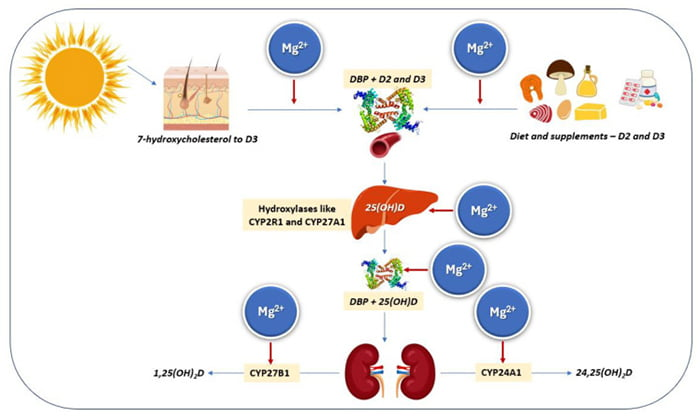
Increasing Proper Magnesium and Vitamin D Levels Benefits Athletic Performance
In related research, a meta-analysis published in the Translational Journal of the American College of Sports Medicine evaluated how magnesium and vitamin D supplementation influence exercise performance and recovery. The researchers reviewed 13 human studies that tested supplementation strategies to figure out what measurable changes show up in performance, fatigue, and recovery.5
The populations covered across the selected studies included recreationally active adults, trained athletes, and physically active individuals with documented nutrient insufficiency. Some trials focused on endurance athletes, others on strength or mixed exercise protocols.
•A consistent, beneficial pattern emerged — Supplementation produced the strongest benefits in people who started with low nutrient status or who trained at higher volumes.
Several trials reported clear improvements in physical performance after magnesium supplementation. The rate of improvement varied by study design, but overall, measurable gains appeared within weeks. In endurance-focused trials, participants showed improved time to exhaustion and reduced oxygen cost during submaximal exercise, meaning they performed the same workload with less effort.
•Physical performance changes — Muscular strength, power output, and endurance capacity improved most often. Some studies reported stronger grip strength and leg power, while others documented longer exercise duration before fatigue set in. Interestingly, these changes also occurred without changes in training volume.
•Benefits were observed right away — Short-term studies lasting four to six weeks already showed performance changes, while longer interventions maintained or slightly enhanced those improvements over time.
•The largest benefits appeared in specific subgroups — Physically active individuals with low baseline magnesium intake or signs of deficiency experienced greater performance gains than those who already met recommended intakes. Endurance athletes, who lose more magnesium through sweat and urine, showed stronger responses than strength-focused athletes in several trials.
•Vitamin D supplementation showed a similar pattern but with more variation — Trials that enrolled participants with low baseline vitamin D levels reported improvements in muscle strength, sprint performance, and recovery markers. In contrast, studies involving participants who already had adequate vitamin D levels showed little change in performance metrics.
•Combining magnesium and vitamin D creates synergistic benefits — When magnesium and vitamin D appeared together in the cited studies, their effects were more favorable compared to single-nutrient approaches. The authors noted that combined sufficiency supported better overall performance outcomes than either nutrient alone in deficient populations. Thus, addressing one while ignoring the other will limit the outcomes.
•Other helpful effects — Several studies reported reduced markers of muscle damage and perceived soreness following supplementation. Participants described themselves feeling less exhausted after training sessions and more prepared for subsequent workouts.
•Biological mechanisms of vitamin D and magnesium — The researchers touched upon the different roles of these nutrients within the context of athletic performance. When it comes to vitamin D, it helps with muscle growth, bone mineralization, and immune function. As for magnesium, it plays a role in muscle strength and cardiorespiratory function.
Practical Strategies to Maintain Optimal Vitamin D Levels
Based on the published findings, vitamin D can help improve your athletic performance. But that’s not all it offers. In previous articles, I’ve noted that it also improves insulin resistance and lowers blood pressure. That said, I’m a big advocate of producing it through sunlight exposure, and only taking a supplement if tests show that you’re still way off target.
1.Prioritize sunlight as your primary vitamin D source — Your skin has a built-in system for producing vitamin D when exposed to direct sunlight. Regular sun exposure on larger areas, such as arms and legs, allows this process to function as best as possible.
Pay attention to how your skin responds. Redness or burning signals excess exposure, while normal skin tone indicates you’re within a safe range. This simple visual check adapts naturally to season, latitude, and skin type, helping you stay within a healthy window.
2.Remove vegetable oil from your diet before increasing midday sun exposure — If you’ve been eating a diet that is high canola, soybean, sunflower, or other vegetable oils, your skin tissues have now accumulated linoleic acid (LA).
When exposed to ultraviolet light, LA oxidizes and causes inflammation and DNA damage, as well as increasing sunburn risk (especially during solar noon). To protect your health, it would be wise to minimize your LA intake to less than 5 grams per day. One way to do this is by replacing vegetable oils with animal fats like tallow, ghee, or grass fed butter.
To monitor your LA intake, I recommend using my Mercola Health Coach app, which is slated for release sometime in 2026. It contains a feature called the Seed Oil Sleuth, which calculates your daily LA consumption to a tenth of a gram. Give your body roughly six months without vegetable oils to allow LA to clear from tissues. As that happens, your tolerance to sunlight improves, and your risk of skin damage diminishes.
Here’s another handy tip — increase your intake of C15:0 fat, also known as pentadecanoic acid, found in grass fed dairy. In a previous article, I noted how it pushes LA out from your tissue, expediting the process further. Read “The Fast-Track Path to Clearing Vegetable Oils from Your Skin” to get the complete details.
3.Choose vitamin D3 and support it with magnesium and K2 — When supplementation becomes necessary, vitamin D3 is the one that your skin produces, while D2 disrupts vitamin D balance and reduces usable D3 levels. Pairing D3 with magnesium and vitamin K2 makes the process safer and more efficient. Magnesium activates vitamin D so your body can use it, and K2 helps guide calcium into bones rather than soft tissues.
These nutrients function as a team. Without magnesium and K2, maintaining healthy vitamin D levels will require you to take far higher doses, which complicates the problem more instead of solving it. Supporting D3 with its cofactors improves efficiency and lowers the likelihood of calcium mismanagement.
4.Check your vitamin D status twice each year — It’s important to have your blood tested to know where you stand. I recommend aiming for 60 to 80 nanograms per milliliter (ng/mL). If results come back low, focus on lowering your LA intake so you can eventually expose your skin during mid-day sun, when vitamin D production is at its greatest. This will also help you determine if you truly need to take a supplement.
You’re Likely Deficient in Magnesium
If you’ve been exercising and correcting your vitamin D levels properly, but you’re not reaching your goals yet, it’s time to check your magnesium levels. Most people are low on cellular energy, and increasing magnesium is one of the quickest ways to reverse it. As noted earlier, it’s bound to ATP. Here’s how you can optimize your magnesium levels:
1.Food oftentimes isn’t enough — Even with a clean, whole-food diet, most people fall short on magnesium. That’s because modern agriculture has stripped the soil of much of its mineral content. This means that vegetables tend to be low in magnesium. And while nuts and seeds contain this mineral, they also contain high levels of LA.
I generally recommend you get your nutrients from food, but magnesium is a rare exception. Reaching the recommended 420 milligrams per day6 through diet alone is difficult.
2.Find your ideal dose using magnesium citrate — This type of magnesium is highly bioavailable and costs little, but it has laxative properties. Instead of viewing that as a downside, use it as a measuring tool. Start with a low amount and slowly increase. When stools turn loose, back down slightly. That point marks your ideal daily dose.
Once you identify the dosage, switch to a gentler form at the same dose. Magnesium glycinate, magnesium malate and magnesium L-threonate are all good choices.
3.Match the magnesium form to your main concern — Not all magnesium supplements work the same way. If tension, irritability, anxiety, or poor sleep are your concerns, magnesium glycinate offers a calming effect without sedation.
If you have low energy, muscle soreness, or brain fog, magnesium malate supports energy production by feeding your mitochondria. When mental clarity and cognitive performance matter most, magnesium L-threonate targets brain tissue more directly.
4.Topical magnesium can also be useful — Magnesium oils, lotions, and bath flakes can also help improve your magnesium status, and provide a pleasant, relaxing sensation. A simple and inexpensive way to boost your magnesium is to take regular Epsom salt baths, especially in the evening.
5.Keep supplementation simple and clean — Choose high-quality magnesium supplements free from artificial colors, fillers, and unnecessary binders.
Frequently Asked Questions (FAQs) About Magnesium and Vitamin D
Q: Why do vitamin D and magnesium matter for athletic performance?
A: Vitamin D and magnesium work together to support muscle contraction, energy production, bone strength, and recovery. When either runs low, strength, endurance, and injury resistance decline, even with consistent training.
Q: How common are vitamin D and magnesium deficiencies in athletes?
A: Large reviews show deficiencies are widespread, including among elite athletes. Significant percentages of professional and Olympic athletes have low vitamin D or magnesium despite high-calorie diets and medical support.
Q: Why don’t standard blood tests always catch magnesium deficiency?
A: Most magnesium exists inside cells, not in blood. Serum magnesium can look normal even when cellular levels stay low, which explains ongoing fatigue, cramps, poor sleep, and slow recovery.
Q: Who benefits most from correcting vitamin D and magnesium levels?
A: Athletes with frequent injuries, performance plateaus, heavy training loads, indoor training, hot environments, or signs of low energy see the greatest improvements once deficiencies are corrected.
Q: What practical steps help restore vitamin D and magnesium levels?
A: Regular sunlight exposure, reducing vegetable oil intake, appropriate vitamin D3 supplementation with magnesium and K2, proper testing, and using well-absorbed magnesium forms at the right dose support long-term performance and recovery.