The University of Michigan Consumer Sentiment Index is one of the clearest windows into how the average American actually feels about the economy.
Each month, the university surveys households across the country, asking straightforward questions about personal finances, job prospects, inflation, and expectations for the future. Those responses are distilled into a single number that captures the public’s economic mood. Because it has been tracked for decades, the index offers a long-running reality check on confidence at the household level.
Today, the University of Michigan Consumer Sentiment Index is sitting near record lows — decisively below levels seen during the 2008 financial crisis, the dot-com bust, and even the deep recessions of the early 1990s and 1980s.

How can stock market valuations be at or near historical highs while the average American is about as pessimistic as they’ve ever been?
This contradiction is a perfect illustration of the financial fun house — and the extreme distortions that relentless money printing has pumped into the system.
If fiat currency is a dishonest measuring stick — and it is — then how do we accurately measure the stock market?
The best option is to measure value in gold, honest money that no politician can arbitrarily debase.
If measuring in fiat is like looking into a fun house mirror, then gold is a mirror of truth. And when we measure the stock market in gold, that truth becomes clear. Below is a chart of the S&P 500 measured in gold going back to 1950.
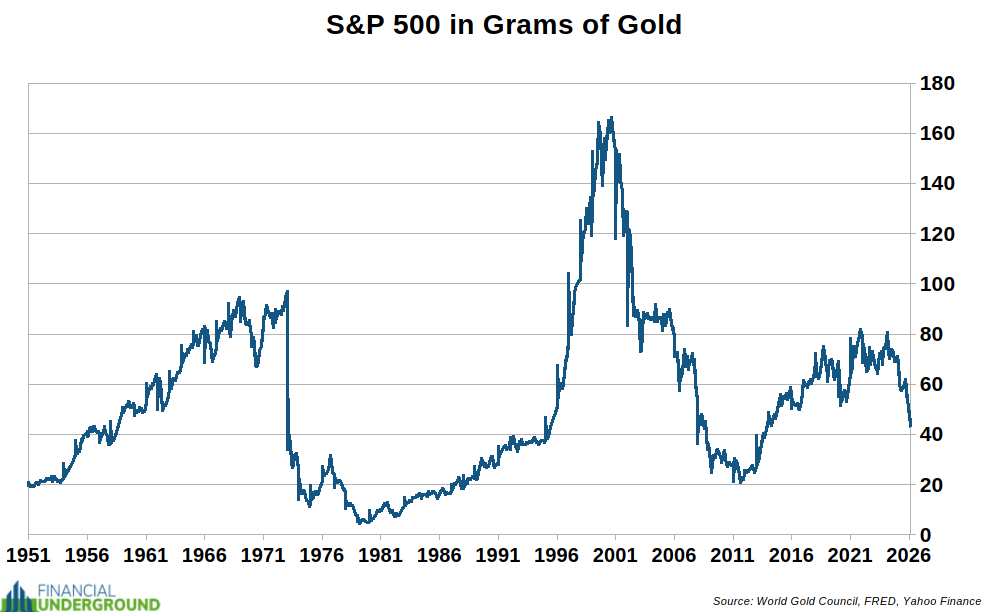
Viewed through the lens of gold, the stock market tells a very different story than it does in fiat terms — and this chart makes that unmistakably clear.
The most striking feature of the chart is what isn’t there: a sustained upward trend. The S&P 500 today is worth the same amount of gold it was in 1995.
Despite decades of nominal gains, the stock market has repeatedly given back those gains when measured against gold. In other words, the rising stock market was more a reflection of currency debasement than of real wealth creation.
This helps explain the disconnect at the heart of today’s market. In fiat terms, stock prices appear to be at record highs. But in gold terms — a unit that cannot be printed — the market looks far less extraordinary.
Measured in gold, US stocks peaked in 1999, when the S&P 500 was worth just over 164 grams of gold. Today, the index is worth 43 grams — a decline of more than 73% from its 1999 peak.
More recently, the S&P 500 peaked at about 82 grams of gold in late 2021. Today, it’s worth roughly 43 grams. In other words, despite the recent melt-up and the stock market ripping to new nominal all-time highs, when measured in gold, the S&P 500 is down more than 47% since late 2021 and sitting at roughly the same level it was in 1995.
In other words, when we look at the stock market through a mirror of truth rather than a fun house mirror, it becomes clear that it is in a deep bear market. It’s no wonder consumer sentiment is near an all-time low.
Despite the nominal melt-up in stocks, most Americans are becoming poorer when measured in real, honest money — not fake government confetti.
I expect this dynamic — a nominal stock market melt-up alongside Americans becoming poorer — to accelerate in 2026. I expect the stock market to go higher and valuations to become even more insane — but I expect gold to rise even faster.
Currency debasement is driving this trend, and unfortunately, all signs point to much more of it in 2026.
This is why the coming phase of this melt-up is so dangerous. Rising stock prices will give the illusion of prosperity, even as the dollar continues to lose purchasing power and real wealth quietly erodes. Most investors will focus on nominal gains and miss what’s actually happening beneath the surface — until it’s too late to respond calmly or intelligently.
To help you see what’s coming before the cracks widen, I’ve prepared a free PDF special report that lays out the larger forces now converging on the financial system.
The Most Dangerous Economic Crisis in 100 Years… the Top 3 Strategies You Need Right Now explains the economic, political, and cultural trends driving this moment, what they mean for your money and personal freedom, and the specific strategies you can use now to protect yourself as this cycle accelerates.
You can get this free PDF report by clicking here and getting access while the window to prepare is still open.