In October 2024, logistics operators working near the Port of Rotterdam began documenting a sequence of irregularities that, at the time, appeared too mundane to attract serious public attention. Several cargo manifests connected to industrial electronics and refrigeration systems were abruptly rerouted through secondary terminals without explanation, while temporary storage contracts — normally renewed monthly — were quietly extended for periods exceeding six months. Within the shipping sector, delays are not uncommon, especially during periods of geopolitical tension or fluctuating fuel costs. What unsettled certain analysts, however, was not the existence of disruptions themselves, but the strangely synchronized manner in which similar anomalies began surfacing across unrelated sectors of European infrastructure almost simultaneously.
By November, warehouse operators in northern Germany had reported unusual procurement requests involving long-term preservation materials, portable filtration systems, industrial batteries, and backup communications equipment. In western Poland, multiple rail-adjacent storage facilities increased private security staffing despite no corresponding rise in theft or civil disturbances. Around the same period, insurance groups operating near Antwerp and Marseille quietly revised several maritime risk models linked to what internal documents allegedly described as “escalating continental instability vectors.”

None of this reached the public in any meaningful way. Individually, each incident remained administratively explainable. Together, however, they formed the outline of something far less ordinary — particularly for those already monitoring the accelerating deterioration of global economic and political cohesion after late 2023.
What makes the current moment difficult to interpret is that modern crises no longer emerge through singular catastrophic events. The twentieth century conditioned populations to expect visible turning points: declarations of war, stock-market crashes, terrorist attacks, assassinations, invasions. The contemporary world operates differently. Instability now accumulates diffusely, almost imperceptibly, through overlapping systemic pressures that erode institutional resilience gradually before suddenly exposing how fragile everything had become beneath the surface.
For most citizens across Europe and North America, daily life still appears superficially intact. Airports remain crowded. Streaming platforms continue producing distractions at industrial scale. Political leaders repeat familiar assurances regarding economic recovery, energy stabilization, and technological growth. Yet beneath this veneer of continuity, a markedly different tone has begun emerging within sectors responsible for contingency planning, cyber defense, food logistics, and emergency governance.
Several independent infrastructure consultants interviewed anonymously during the first quarter of 2025 described a growing atmosphere of “managed anticipation” inside governmental and corporate planning circles — a phrase that appears repeatedly in leaked briefing fragments circulated among private security communities earlier this year. The term itself is revealing. It does not imply immediate collapse. Rather, it reflects the increasing expectation that multiple destabilizing events are no longer hypothetical risks to be modeled theoretically, but statistically plausible disruptions requiring active preparation.
This distinction matters far more than most people realize.
For over a decade, Western governments approached systemic risk primarily through compartmentalization. Economic instability belonged to economists. Cybersecurity threats remained within intelligence agencies. Migration pressures were handled politically. Energy vulnerability was treated as a market issue. Artificial intelligence belonged to the technology sector. Today, however, those categories are beginning to converge in ways many institutions appear structurally incapable of managing coherently.
The problem is not simply that the world is becoming unstable. The problem is that instability itself is becoming interconnected.
A cyberattack affecting maritime logistics now impacts food distribution. Energy disruptions trigger political radicalization. Artificial intelligence accelerates labor uncertainty while simultaneously amplifying disinformation ecosystems already eroding public trust. Currency volatility influences migration flows, which in turn reshape electoral politics across increasingly polarized societies. What once existed as isolated fractures are now behaving more like synchronized stress reactions inside a tightly interconnected global system.
Several months ago, a little-noticed policy forum hosted in Brussels included an off-record discussion involving infrastructure analysts, defense consultants, and emergency planning officials from multiple NATO-aligned states. According to attendees who later spoke privately to independent researchers, one recurring concern dominated the conversations behind closed doors: not whether future crises would occur, but whether governments still possessed the administrative elasticity necessary to absorb overlapping shocks without triggering cascading public instability.
One participant allegedly summarized the concern bluntly:
“The system was designed for isolated emergencies. It was never designed for permanent pressure.”
That sentence circulated quietly across several encrypted discussion groups afterward because it reflected a growing fear among strategic analysts worldwide — namely, that modern governments have become extraordinarily efficient at managing optics while simultaneously becoming less capable of maintaining structural resilience beneath those optics.
This perception intensified considerably after a sequence of infrastructure anomalies occurring between late 2024 and early 2025. In Spain and portions of southern France, intermittent telecommunications failures disrupted payment systems for several hours longer than publicly acknowledged. Scandinavian freight monitoring networks reportedly experienced unexplained satellite synchronization problems affecting cargo routing data. In eastern Europe, multiple regional power-transfer facilities underwent abrupt “maintenance operations” immediately following suspected cyber intrusion attempts that were never formally disclosed.
Again, none of these incidents individually prove anything extraordinary.
Yet the cumulative pattern has become increasingly difficult for serious observers to ignore.
THE ARCHITECTURE OF FRAGILITY
Modern civilization depends on a level of systemic synchronization unprecedented in human history. Food arrives in cities not because nations possess abundant local reserves, but because logistics algorithms continuously coordinate thousands of moving variables across continents in real time. Financial markets operate through invisible digital architectures that most citizens neither understand nor even consciously perceive. Energy grids rely upon intricate balancing systems vulnerable not only to physical disruption, but increasingly to software compromise and algorithmic interference.
The average urban population experiences this complexity only through convenience. Electricity flows. Deliveries arrive. Transactions process instantly. Fuel stations remain stocked. Water emerges from taps. This seamless functionality creates the illusion of permanence, even though the underlying infrastructure supporting modern life has become remarkably sensitive to disruption.
One internal European risk assessment leaked briefly online before being removed described this vulnerability using unusually direct language:
| Critical Sector | Estimated Time Before Major Public Disruption |
|---|---|
| Digital Payment Systems | 6–12 Hours |
| Urban Food Distribution | 72 Hours |
| Fuel Logistics | 4–6 Days |
| Emergency Medical Supply Chains | 7 Days |
| Telecommunications Stability | 24–48 Hours |
The report itself was never authenticated publicly, though several cybersecurity researchers later claimed its formatting resembled legitimate intergovernmental infrastructure briefings. What drew attention was not merely the table, but the implication behind it: highly developed societies may be far less resilient than their populations assume.
This concern has become especially pronounced among specialists studying what are now called compound destabilization events — scenarios in which multiple low-to-moderate crises occur simultaneously across different sectors, overwhelming governments not through intensity, but through cumulative administrative exhaustion.
Consider the following hypothetical sequence, increasingly referenced within strategic forecasting circles:
- A prolonged cyberattack disrupts maritime logistics in northern Europe.
- Fuel distribution delays begin affecting agricultural transport.
- Panic buying spreads through social media amplification.
- Localized energy shortages emerge during winter demand peaks.
- Financial markets react violently to perceived instability.
- Public distrust accelerates faster than official communication can contain it.
Individually, none of these stages constitute civilization-ending catastrophes. Together, however, they create precisely the kind of cascading psychological destabilization modern societies appear uniquely vulnerable to experiencing.
This is where the discussion surrounding artificial intelligence becomes particularly disturbing.
Public conversations about AI remain dominated by automation, employment displacement, and generative media. Far less attention has been devoted to its emerging role in informational destabilization. Several intelligence-linked cybersecurity groups have already warned privately that AI-generated influence systems may soon render traditional methods of distinguishing authentic events from manufactured narratives almost impossible for average populations.
The consequences extend far beyond misinformation.
Once public trust deteriorates beyond a certain threshold, every institutional statement — regardless of accuracy — begins losing stabilizing power. Governments require informational credibility during crises. Without it, even manageable disruptions can escalate into mass behavioral volatility.
And signs of that erosion are already visible.
Recent polling across multiple Western democracies indicates historically low levels of confidence in political leadership, media organizations, financial institutions, and even electoral systems themselves. Simultaneously, online ecosystems increasingly reward emotional intensity over factual coherence, accelerating fragmentation within already polarized societies.
Several sociologists studying late-stage institutional trust deterioration have noted a dangerous historical pattern: populations rarely panic because conditions become objectively catastrophic. More often, panic emerges when populations lose confidence that authorities genuinely understand what is happening.
That distinction may become critically important during the years ahead.
Because the deeper issue lurking beneath the visible geopolitical tensions of 2025 is not merely war, recession, migration, or cyber conflict individually. It is the growing possibility that many institutions responsible for managing instability are themselves beginning to experience structural fatigue after years of continuous global pressure.
And fatigue, unlike crisis, is far more difficult to announce publicly.
What has alarmed a growing number of regional planners is the increasing concentration of vulnerabilities around several strategic corridors that, until recently, received almost no attention outside specialized defense or infrastructure circles. One of these stretches from the industrial ports of the Netherlands through western Germany and into portions of eastern Europe heavily dependent on synchronized energy routing and rail freight movement. Another extends across the Baltic telecommunications network, where undersea cable damage — once considered statistically rare — has become disturbingly recurrent over the past eighteen months.
Analysts monitoring maritime insurance fluctuations have privately noted that certain shipping routes now display risk indicators previously associated only with active conflict zones. Publicly, these fluctuations are explained through conventional factors: piracy concerns, fuel volatility, sanctions pressure, labor disputes. Yet some observers believe a more profound recalibration is occurring beneath the surface, particularly among institutions preparing for scenarios involving prolonged continental instability rather than isolated geopolitical incidents.
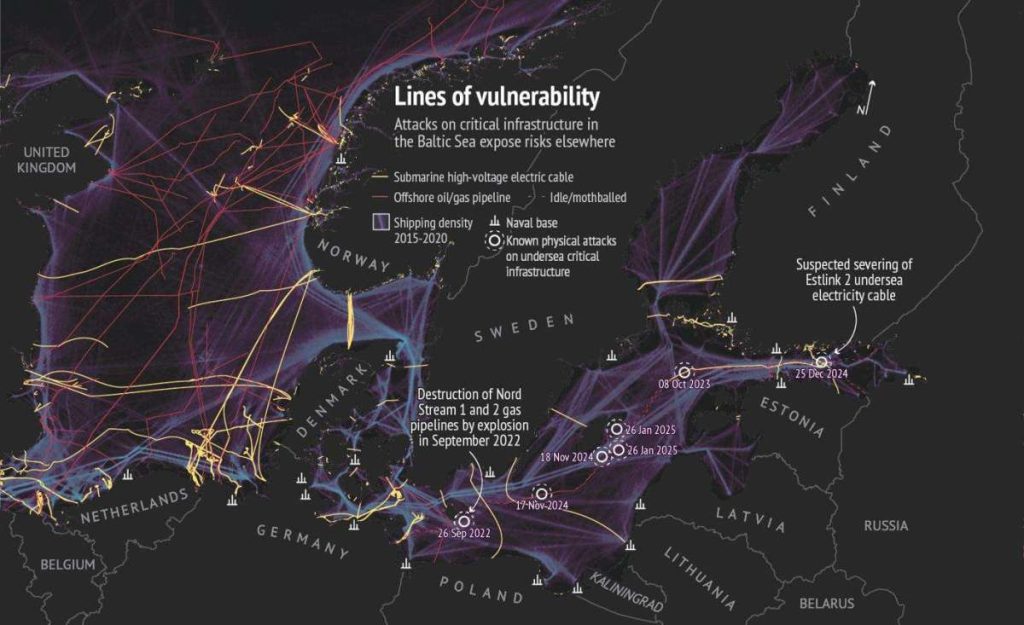
Several former defense contractors interviewed anonymously over recent months described an atmosphere inside strategic planning circles that feels markedly different from the post-Cold War optimism that dominated Western institutions for decades. One consultant who previously worked alongside infrastructure resilience teams in central Europe explained that contingency discussions have gradually shifted away from preparing for singular disasters and toward modeling what officials now refer to internally as persistent disruption environments — periods in which instability never fully disappears, but instead mutates continuously across economic, digital, political, and social domains.
That shift in language may appear semantic. It is not.
Governments historically prepare populations psychologically for temporary emergencies. Storms pass. Markets recover. Wars conclude. The assumption underlying modern democratic stability has always been that disruption remains exceptional rather than permanent. What appears to be emerging now is something considerably more disquieting: the normalization of chronic instability itself.
This transformation is already visible in subtle ways most populations barely register consciously. Across major European cities, physical security infrastructure has expanded almost invisibly over the last three years. Bollards, surveillance systems, biometric checkpoints, autonomous monitoring platforms, and predictive policing technologies have proliferated under the justification of public safety modernization. Simultaneously, emergency preparedness messaging has quietly intensified in several countries without corresponding explanations for why such acceleration became necessary so suddenly.
In parts of Scandinavia, updated civil defense guidance encouraged households to maintain extended reserves of water, batteries, medicine, and non-perishable food supplies. Officially, these campaigns were framed as precautionary resilience initiatives connected to evolving global uncertainty. Unofficially, some regional analysts interpreted them as evidence that governments increasingly expect interruptions to ordinary infrastructure reliability during the coming decade.
The psychological implications of this transition are difficult to overstate.
Modern populations have spent generations internalizing the assumption that systems fundamentally work. Electricity failures are temporary. Banks reopen. Networks recover. Fuel returns. The possibility that highly developed societies could experience prolonged fragmentation remains almost psychologically incompatible with the worldview most citizens inherited during the late twentieth century. Yet this very expectation of continuity may itself become a vulnerability if future disruptions begin exceeding public tolerance thresholds.
A confidential risk memorandum circulated among private insurers earlier this year reportedly included an especially unsettling observation regarding urban behavioral response patterns during prolonged infrastructure instability. According to excerpts shared anonymously online, researchers concluded that social cohesion in technologically dependent metropolitan populations deteriorates significantly faster than traditional emergency models previously assumed. The reason is not necessarily scarcity itself, but informational ambiguity.
People panic less when they understand what is happening.
They panic when nobody appears capable of explaining it coherently.
That phenomenon became partially visible during several recent infrastructure incidents that, while relatively limited operationally, generated disproportionate psychological reactions online. Temporary banking disruptions triggered rumors of financial freezes. Minor telecommunications outages rapidly evolved into speculation regarding cyber warfare. Isolated shortages became interpreted as evidence of systemic collapse. In highly networked societies saturated by algorithmically amplified fear, perception itself increasingly behaves like a destabilizing force independent of objective reality.
This is precisely why certain strategic analysts now consider informational volatility as dangerous as physical disruption.
The distinction between authentic crisis and perceived crisis is beginning to erode.
And once that boundary weakens sufficiently, governments may discover that maintaining public trust becomes substantially harder than maintaining infrastructure itself.
What appears increasingly evident, however, is that many governments have already begun adapting psychologically to a world in which prolonged instability is no longer treated as an exceptional interruption, but rather as a semi-permanent operating condition. This distinction may sound abstract from the outside, yet it fundamentally alters how institutions behave behind closed doors. Systems designed for temporary emergencies prioritize recovery. Systems preparing for chronic volatility prioritize continuity, containment, and control.
That subtle transition can already be observed in the language emerging from policy circles over the past year. Terms such as “resilience adaptation,” “distributed redundancy,” “critical continuity management,” and “societal stabilization frameworks” have appeared with increasing frequency across infrastructure, defense, and economic planning sectors. On paper, these phrases sound administrative — almost sterile. In practice, they reflect a deeper recognition that the structural assumptions underpinning globalization during the past three decades may be beginning to fracture under cumulative pressure.
And pressure is precisely what defines the current geopolitical climate.
Not singular catastrophe. Not total collapse. Pressure.
Economic pressure generated by unsustainable debt structures and inflationary stagnation. Political pressure resulting from ideological polarization severe enough to paralyze legislative systems. Technological pressure accelerated by artificial intelligence advancing faster than regulatory institutions can realistically absorb. Demographic pressure linked to migration, aging populations, and deteriorating urban affordability. Informational pressure produced by populations existing inside permanently agitated digital environments where outrage has become both commodity and governance obstacle simultaneously.
What makes this convergence historically unusual is not merely the number of crises occurring concurrently, but the growing inability of institutions to isolate them from one another. Problems now behave less like independent events and more like interconnected contagions moving through shared infrastructure systems.
A prolonged cyber disruption no longer remains a technological issue alone. It becomes:
- a financial issue,
- a logistics issue,
- a psychological issue,
- a political issue,
- and eventually a security issue.
Likewise, energy instability no longer affects only utilities or industrial output. It rapidly influences:
- electoral volatility,
- food pricing,
- transportation reliability,
- manufacturing continuity,
- and ultimately social cohesion itself.
This interdependence has forced strategic planners to reconsider assumptions previously treated almost as immutable truths within modern governance. Several defense-oriented forecasting groups have reportedly begun focusing less on “high-impact apocalyptic events” and more on what they describe as cumulative degradation environments — scenarios where societies remain technically functional while gradually becoming more brittle, more anxious, and substantially more difficult to stabilize politically.
That nuance matters enormously because most populations still imagine systemic crisis in cinematic terms: sudden blackouts, military invasions, catastrophic detonations, visible collapse. Real destabilization often unfolds differently. It advances incrementally through deteriorating trust, administrative fatigue, economic exhaustion, and the slow normalization of dysfunction until populations adapt psychologically to conditions they once would have considered intolerable.
This phenomenon became increasingly visible across several Western cities throughout early 2025. Infrastructural irregularities that previously would have generated major public outrage now disappear from headlines within days. Banking outages, transportation failures, energy spikes, digital surveillance expansions, emergency legislation, aggressive policing measures — all increasingly absorbed into the background rhythm of everyday life with surprisingly limited resistance.
Some sociologists refer to this process as adaptive normalization: the gradual expansion of what populations are willing to psychologically accept after prolonged exposure to instability.
Historically, societies entering such phases often experience several overlapping behavioral shifts:
- Attention fragmentation
Continuous crisis exposure reduces the public’s ability to maintain sustained focus on any single issue, allowing structural changes to occur with minimal scrutiny. - Emotional desensitization
Populations become psychologically numb to events that previously would have provoked significant civic reaction. - Institutional dependency paradox
Distrust toward governments increases simultaneously with dependency upon those same institutions during periods of uncertainty. - Localized tribalization
Citizens increasingly retreat into ideological, economic, or digital micro-communities rather than participating within broader national consensus structures. - Security prioritization over liberty
During prolonged uncertainty, populations historically become more willing to tolerate surveillance and centralized control mechanisms in exchange for perceived stability.
Several analysts monitoring European policy trends argue that the final point may become particularly consequential during the coming decade. Across multiple regions, emergency governance powers initially introduced as temporary responses to specific crises have quietly remained in place far longer than originally anticipated. Measures associated with financial monitoring, digital identification systems, online speech regulation, predictive behavioral analysis, and biometric tracking continue expanding incrementally under the justification of combating extremism, disinformation, cybercrime, or public disorder.
Individually, each policy adjustment appears manageable.
Collectively, however, they suggest the gradual emergence of a political environment increasingly oriented around preemptive control rather than reactive governance.
This shift has not gone unnoticed among civil-liberty researchers, several of whom have warned that societies experiencing chronic instability often drift toward what political theorists historically described as managed democracies — systems where electoral mechanisms technically remain intact while decision-making becomes progressively centralized around permanent emergency administration.
Whether such warnings prove exaggerated remains impossible to determine conclusively at present. Yet the broader trajectory is difficult to ignore. Governments worldwide appear increasingly preoccupied not merely with external threats, but with maintaining internal stability under conditions of mounting societal strain.
And perhaps that, more than anything else, explains the strange atmosphere that has settled over much of the developed world recently — the pervasive sensation that institutions are preparing quietly for something they remain unwilling to describe openly.
Not because collapse is imminent.
But because confidence itself may already be deteriorating faster than officials are prepared to admit publicly.
Toward the middle of 2025, a phrase began surfacing with increasing frequency among macroeconomic strategists, intelligence-adjacent consultants, and infrastructure analysts operating far from public visibility. The phrase itself sounded deceptively technical — controlled deterioration — yet the implications behind it were profoundly unsettling. It referred to the growing belief that certain institutions were no longer attempting to fully restore the stable global equilibrium that defined the early twenty-first century because, privately, many no longer believed such equilibrium remained realistically recoverable.
Instead, the objective appeared to be shifting toward something else entirely: managing decline slowly enough to avoid synchronized systemic panic.
Whether this interpretation is accurate remains impossible to verify conclusively. Governments rarely communicate transparently during periods of structural uncertainty, and institutions facing fragility almost always prioritize social stabilization over full disclosure. Nevertheless, several developments occurring across finance, energy, and geopolitical planning over the last eighteen months suggest that portions of the global administrative apparatus may indeed be preparing for a future considerably harsher than official rhetoric implies.
Perhaps nowhere is this more visible than in the widening disconnect between economic indicators and lived reality.
On paper, many economies continue reporting moderate growth. Employment figures remain superficially stable in several Western states. Consumer activity, while weakened, has not fully collapsed. Yet beneath these metrics lies an increasingly visible exhaustion spreading through entire sections of society — particularly among younger populations facing housing inaccessibility, permanent financial precarity, deteriorating purchasing power, and an almost continuous exposure to digital anxiety environments.
This matters because economic instability alone rarely destabilizes advanced societies.
Psychological exhaustion does.
Historically, civilizations become vulnerable not merely when conditions worsen materially, but when populations lose confidence that sacrifice will eventually produce improvement. Once large portions of society begin perceiving the future itself as structurally compromised, political extremism, civic fragmentation, and institutional distrust tend to accelerate simultaneously.
Several demographic studies conducted throughout 2024 and early 2025 already suggest this process may be underway across multiple developed nations. Rising percentages of respondents — especially under forty — increasingly describe the future using language associated not with ambition, but with survival, uncertainty, or decline. Confidence in long-term institutional competence has deteriorated sharply across sectors once considered foundational: education, healthcare, banking, journalism, electoral governance, and international diplomacy.
What emerges from this psychological landscape is not immediate revolution, but something potentially more dangerous: societal disengagement.
And disengaged societies are extraordinarily difficult to stabilize during periods of prolonged stress.
This concern appears repeatedly within strategic forecasting literature connected to urban resilience planning. Several internal assessments leaked over recent months reportedly warned that large metropolitan populations may become increasingly vulnerable to what analysts describe as fragmented response behavior during future crises. In simple terms, populations stop reacting collectively. Shared narratives disappear. Consensus collapses. Every disruption becomes interpreted through incompatible ideological frameworks, making coordinated stabilization vastly more difficult for authorities attempting to maintain order.
The implications become especially severe when combined with accelerating artificial intelligence systems capable of manufacturing persuasive narratives, synthetic evidence, and emotionally optimized disinformation at industrial scale.
Only a few years ago, manipulated information still required substantial organizational effort. Today, entire ecosystems of fabricated media can be generated automatically, customized psychologically, and distributed globally within hours. Several cybersecurity groups have already warned privately that populations may soon enter an environment where distinguishing authentic geopolitical events from engineered informational warfare becomes functionally impossible for ordinary citizens.
That possibility alone carries destabilizing consequences.
Because once populations stop trusting the authenticity of information itself, every institution dependent upon public credibility begins weakening simultaneously:
- governments,
- financial systems,
- emergency services,
- elections,
- journalism,
- even objective reality as a shared civic framework.
Some researchers now refer to this emerging condition as epistemic fragmentation — the collapse of collective agreement regarding what is true, false, manipulated, or real. Historically, societies experiencing severe epistemic fragmentation rarely remain politically stable for long because democratic governance fundamentally depends upon populations sharing at least a minimal perception of common reality.
Without that foundation, fear expands rapidly into the vacuum.
And fear, once chronic, reshapes societies more profoundly than most governments are willing to acknowledge publicly.
This may partially explain why so many institutions now appear increasingly focused on predictive surveillance, behavioral analytics, digital monitoring systems, and preemptive social management technologies. Officially, these tools are presented as safeguards against extremism, cybercrime, foreign interference, or violent radicalization. Unofficially, however, some analysts believe governments understand they may soon confront populations experiencing unprecedented levels of psychological instability under conditions of economic, technological, and geopolitical pressure converging simultaneously.
Several private-sector intelligence briefings circulated earlier this year allegedly modeled scenarios involving:
- prolonged urban infrastructure disruption,
- synchronized cyber-financial attacks,
- cascading supply-chain failures,
- AI-generated mass disinformation events,
- and large-scale civil disorder amplified through autonomous digital networks.
What disturbed several observers was not merely the existence of these simulations — governments routinely prepare for worst-case contingencies — but the increasing frequency with which such scenarios now appear interconnected rather than isolated.
That convergence may ultimately define the decade ahead.
Not one catastrophic event.
Not one war.
Not one economic collapse.
But the cumulative weight of continuous instability gradually reshaping political systems, public psychology, economic behavior, and civil trust simultaneously until societies become almost unrecognizable compared to the world that existed only a decade earlier.
And perhaps this is why so many people, despite struggling to articulate it precisely, increasingly sense that something fundamental has shifted beneath the surface of ordinary life. The sensation appears everywhere now — in financial anxiety, in the exhaustion visible across major cities, in the growing distrust toward institutions, in the strange normalization of surveillance, in the endless cycle of crisis headlines that no longer fully disappear before the next arrives.
People feel it because, at some level, societies often recognize structural change subconsciously before they understand it intellectually.
The unsettling possibility is that the current era may not represent a temporary deviation from stability, but the early phase of a far longer transformation already underway.
A transformation defined not by sudden apocalypse, but by gradual systemic hardening:
- more surveillance,
- less transparency,
- weaker trust,
- stronger control mechanisms,
- fragmented populations,
- permanent uncertainty,
- and governments increasingly preoccupied with continuity rather than prosperity.
If that trajectory continues, historians may eventually look back on the period between 2020 and 2025 not as the aftermath of isolated crises, but as the opening stage of a prolonged global realignment that most populations failed to recognize while it was happening.
And by the time such transitions become fully visible historically, they are usually already far too advanced to reverse easily.