Let’s discuss more repercussions of a foolish war with Iran surface.
Water Is Now a Key Issue
The Wall Street Journal reports Attacks on Desalination Drag Water Supplies Into the War With Iran

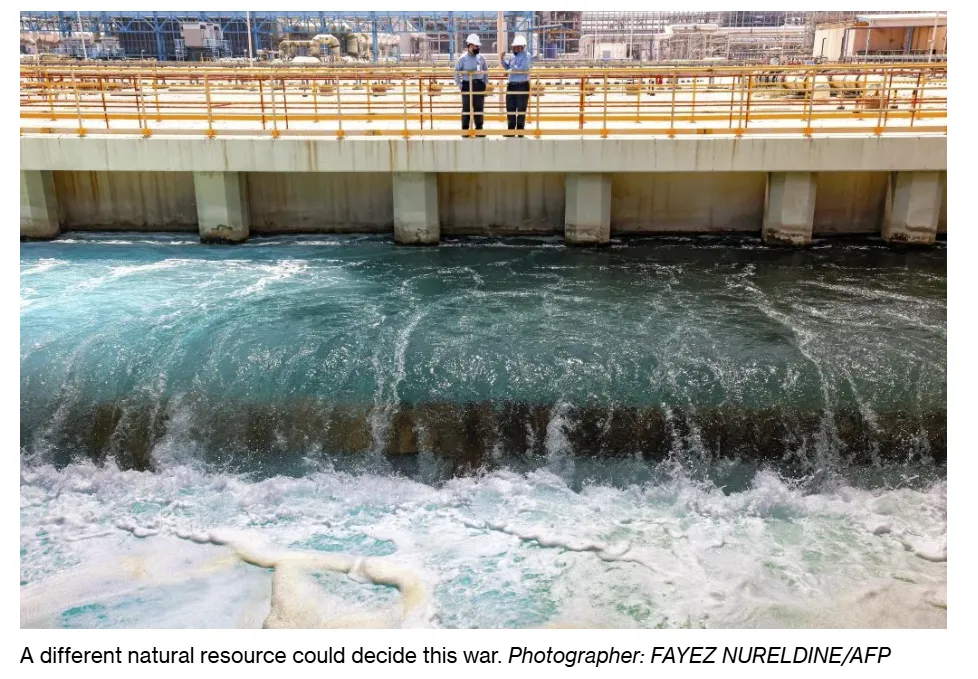
An Iranian drone attack damaged a desalination plant in Bahrain, bringing the war to the oil-rich Persian Gulf’s most strategic resource: drinking water.
The attack did material damage, the Gulf state’s Interior Ministry said Sunday. Iran hadn’t addressed the attack, but a day earlier Iranian Foreign Minister Abbas Araghchi said the U.S. had attacked an Iranian desalination plant on the Gulf island of Qeshm. “The U.S. set this precedent, not Iran,” Araghchi said on social media.
A spokesman for the U.S. Central Command, which is responsible for the Middle East, denied that the military hit a desalination plant in Iran.
With desalination plants, the set of infrastructure targets being struck in the war has expanded, marking a new and dangerous escalation in a region where many countries have limited onshore sources of fresh water.
The Middle East’s abundant desalination plants, which remove salt from the Persian Gulf’s seawater, are the key source of drinking water for millions of residents in the arid region.
“It’s really going for the jugular, and in a major way,” said Hussein Ibish, a senior resident scholar at the Arab Gulf States Institute, a Washington think tank. “These desalination plants, even more than the energy infrastructure of the Gulf monarchies, are their Achilles’ heel.”
The Middle East accounts for more than 40% of the world’s desalination capacity, with around 5,000 plants feeding its water systems.
Bahrain, where the drone strike occurred, is almost completely dependent on its plants for drinking water for its population of 1.6 million. Israel depends on the plants for about 80% of its drinkable water. About 90% of Kuwait’s water needs are met by desalination.
US May Have Started This
Water Could Decide the Middle East’s Fate
Bloomberg reports In the Iran War, Water Could Decide the Middle East’s Fate
The CIA calls it the “strategic commodity” of the Middle East. But it’s not referring to oil or natural gas. What the American spy agency has in mind is far more prosaic: drinking water. Don’t underestimate it, though, because if military hostilities continue to escalate, water could become the geopolitical commodity that decides the war between the US and Iran.
The US Central Intelligence Agency has been briefing American policymakers for decades on the inherent risk of relying on those plants for such a crucial supply. In a secret assessment in the early 1980s — since declassified — the CIA said: “Senior government officials in some of the countries perceive it [water] as more important than oil to the national well-being.”
About 100 million people live in the countries belonging to the Gulf Cooperation Council — Saudi Arabia, Kuwait, Bahrain, Qatar, the United Arab Emirates and Oman — all now under Iranian attack. Kuwait, Qatar and the UAE are, for all practical purposes, completely dependent on the desalination plants, particularly for metropolises such as Dubai. Saudi Arabia, and especially its capital, Riyadh, also relies heavily on them.
Under international law, the desalination plants are protected. But I have seen enough Middle Eastern wars to know the weight of the Geneva Conventions when missiles and bombs start flying. And they are: Iran has attacked a power station in Fujairah, UAE that keeps one of the world’s largest desalination plants running. In Kuwait, debris from a drone interception caused a fire in one of the country’s plants.
The risk is enormous. Take the Jubail desalination plant, located on the Persian Gulf coast of Saudi Arabia. It supplies Riyadh, via a roughly 500-kilometer-long pipeline system, with more than 90% of its drinking water. “Riyadh would have to evacuate within a week if the plant, its pipelines, or associated power infrastructure were seriously damaged or destroyed,” according to a 2008 memo from the US embassy in the kingdom released by Wikileaks.
Still, Iran doesn’t have many options to prevail. Militarily, it cannot escalate against the combined Israeli-American war machine. Its only options are hunker down, in the hope that a long-lasting conflict becomes economically too painful for its enemies, or go after so-called soft targets like energy sites, airports and water installations. From its actions, it’s clear the Islamic Republic has chosen to hit soft targets and hunker down, hoping to outlast the assault. Ultimately, the Islamic Republic sees surviving as winning — even if victory comes with immense losses.
UAE, Central Israel Hit With Missile Attacks
Bloomberg reports UAE, Central Israel Hit With Missile Attacks
The UnitedNations World Food Programme has warned that surging food and fuel prices caused by the conflict in the Middle East will push vulnerable populations in the region and beyond closer towards severe food insecurity.
The escalating supply chain pressures impacting fertilizers, oil and energy are increasing costs for WFP’s operations. Longer transit times are also delaying humanitarian deliveries.
US Tries to Pass the Buck on Rising Gas Prices
US Energy Secretary Chris Wright said any missile strikes on Iranian oil refineries or other infrastructure would be the work of the Israeli military, not the US.
“We have no plans to target” the Iranian oil industry, Wright said on CNN’s State of the Union. “This must be Israel.”
Nightmare Scenario
Daniel Yergin, vice chairman of S&P Global, says the world is facing what could become the “nightmare scenario” for global energy markets if the Middle East conflict drags on.
Speaking on Bloomberg This Weekend, Yergin pointed to the unprecedented disruption. While oil prices have surged above $90 per barrel, he believes we’re not yet at the worst-case scenario.
“The nightmare scenario would be a war that goes on a long time, a disruption that goes on a long time. Prices really skyrocketing — 90 is high, but it’s not skyrocketing — with major impacts on financial markets and ultimately the world economy plummeting into a recession.”
Among many other things, the Trump administration forgot to factor in water.
Dear president Trump, you forgot to note, Iran isn’t Venezuela.
Related Posts
March 7, 2026: Kuwait Petroleum Declares Force Majeure on Sales of Oil and Refinery Products
Expect another surge in oil and gasoline prices.
March 7, 2026: Trump Threatens Iran with “Complete Destruction and Certain Death”
Iran rejects surrender and Trump delivers an amazing rant.
March 7, 2026: US Ground Troops to Iran? Trump Now Says “If Very Good Reason”
Hey, let’s completely fight Israel’s war that we started.
Are we starting to see “Very Good Reason” for ground troops?
This post originated on MishTalk.Com
Thanks for Tuning In!
Mish