
Trump’s son-in-law Jared Kushner and Steve Witkoff have a new vision for Gazalago.
Please note the highly implausible ‘Project Sunrise’ Plan to Turn Gaza Into High-Tech Metropolis
Beachside luxury resorts. High-speed rail. AI-optimized smart grids.
Welcome to “Project Sunrise,” the Trump administration’s pitch to foreign governments and investors to turn Gaza’s rubble into a futuristic coastal destination.
A team led by President Trump’s son-in-law Jared Kushner and Middle East envoy Steve Witkoff, two top White House aides, developed a draft proposal to convert the bombed-out enclave into a gleaming metropolis. In 32 pages of PowerPoint slides, replete with images of coastal high-rises alongside charts and cost tables, the plan outlines steps to take Gaza residents from tents to penthouses and from poverty to prosperity.
The presentation is labeled “sensitive but unclassified,” and doesn’t go into details about which countries or companies would fund Gaza’s rebuilding. Nor does it specify where precisely the 2 million displaced Palestinians would live during reconstruction. The U.S. has shown the slides to prospective donor countries, U.S. officials said, including wealthy Gulf kingdoms, Turkey and Egypt.
“They can make all the slides they want,” said Steven Cook, a senior fellow for the Middle East at the Council on Foreign Relations think tank who just traveled to Israel but didn’t see the draft. “No one in Israel thinks they will move beyond the current situation and everyone is okay with that.”
The project, according to the draft, would cost a total of $112.1 billion over 10 years, though the U.S. would commit to being an “anchor” supporting nearly $60 billion in grants and guarantees on debt for “all the contemplated workstreams” in that time period. Gaza could then self-fund many projects over the following years of the plan, the proposal projects, and eventually pay down its debt as improvements fuel local industry and the broader economy.
The proposal acknowledges on the second page, bold and in red, that Gaza’s reconstruction depends on Hamas “to demilitarize and decommission all weapons and tunnels.”
The rebuild would proceed in four phases, starting in the south with Rafah and Khan Younis before moving northward to “center camps” and, finally, the capital Gaza City.
One slide, titled “New Rafah,” sees it serving as Gaza’s “seat of governance” and home to more than 500,000 residents. They would live in a city with more than 100,000 housing units, 200 or more schools, and more than 75 medical facilities and 180 mosques and cultural centers.
The plan estimates the entire effort would cost $112.1 billion, including the public-sector payroll, over those 10 years, with much of it at the start going to humanitarian needs. Just under $60 billion would be financed by grants ($41.9 billion) and new debt ($15.2 billion) in that time period, with the U.S. offering to “anchor” 20% or more of the support. The World Bank would also play a financing role.
Costs are projected to taper off as Gaza makes money heading into the plan’s second decade. The proposal calls for monetizing 70% of Gaza’s coastline beginning in year 10, and estimates the glitzy riviera could lead to over $55 billion in long-run investment returns.
A three-phase plan is still in “Phase 1,” as Hamas has yet to hand over its last hostage—the body of Ran Gvili. If that happens, Israeli forces can begin their withdrawal from Gaza in “Phase 2” as Hamas lays down its arms, vowing never to seek power in the enclave again. Only then, with Gaza no longer home to Hamas militants or occupied by Israeli forces, could the multi-year rebuild begin in “Phase 3.”

From This to Gazalago
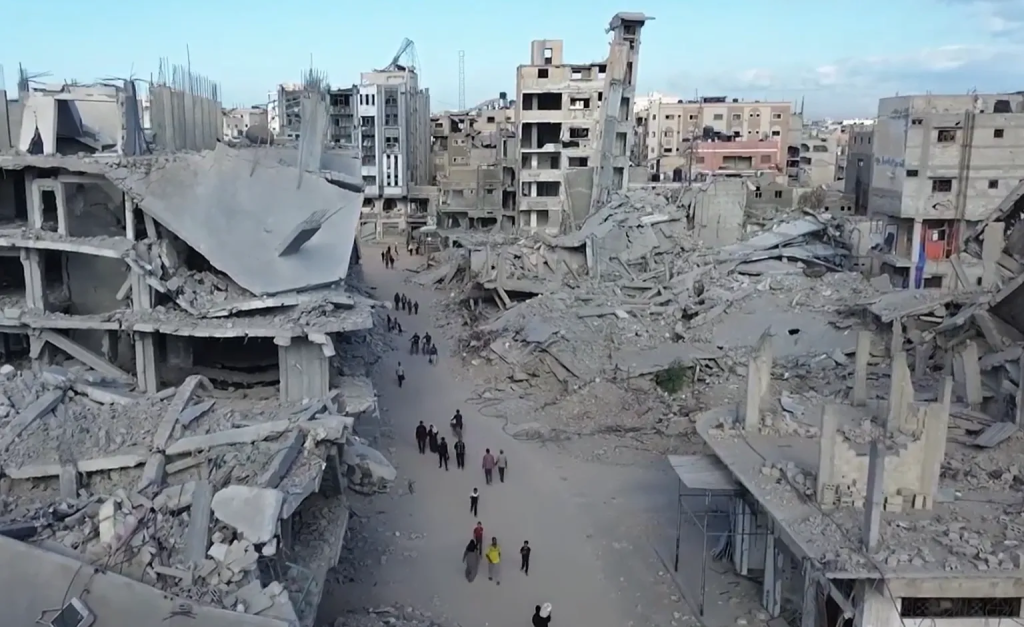
Please note Gaza Sits Under 68 Million Tons of Rubble.
Thousands of Israeli airstrikes, along with fighting on the ground and controlled demolitions, have destroyed more than 123,000 buildings in the Gaza Strip and left an additional 75,000 damaged to varying degrees, accounting for 81% of all the structures in the enclave, according to the latest review of satellite images by the United Nations.
That has generated about 68 million tons of debris, according to the U.N. Development Program, which is overseeing rubble removal in Gaza. That is equivalent to the weight of around 186 Empire State Buildings. Distributing that amount of rubble evenly across Manhattan would leave around 215 pounds of debris on every square foot.
The rubble is mixed with unexploded ordnance—the bombs, missiles, rocket and artillery projectiles that failed to detonate. There are also human remains—the bodies of some 10,000 people which remain trapped beneath the rubble, according to Palestinian health authorities.
The work to remove the rubble can only begin in earnest if Israeli authorities allow into Gaza heavy machinery and equipment needed to move debris and destroy unexploded ordnance.
Meanwhile, the living conditions for Gaza’s more than 2 million residents remain dire. Most Palestinians are staying in tents pitched in overcrowded camps for the displaced and rubble-strewn streets. The onset of winter has worsened conditions, with heavy rains flooding camps.
How long, exactly, will depend on funding, Israel’s willingness to allow the necessary equipment into Gaza and the political will on both sides to keep the cease-fire in place.
The U.S. is hoping Arab Gulf states will foot a big part of the overall reconstruction bill, which the U.N. estimates will be around $70 billion. No agreement has been reached.
I would like to see the plans, but cannot find them anywhere. All the stories link back to the Wall Street Journal article at the top of this post.
But we have seen enough to know this is a major Fantasyland proposal.
Anyone care to guess the odds of success for this plan as described?
This post originated on MishTalk.Com
Thanks for Tuning In!
Mish